
 Wildlife
of Mongolia
Great Grey Owl
Strigidae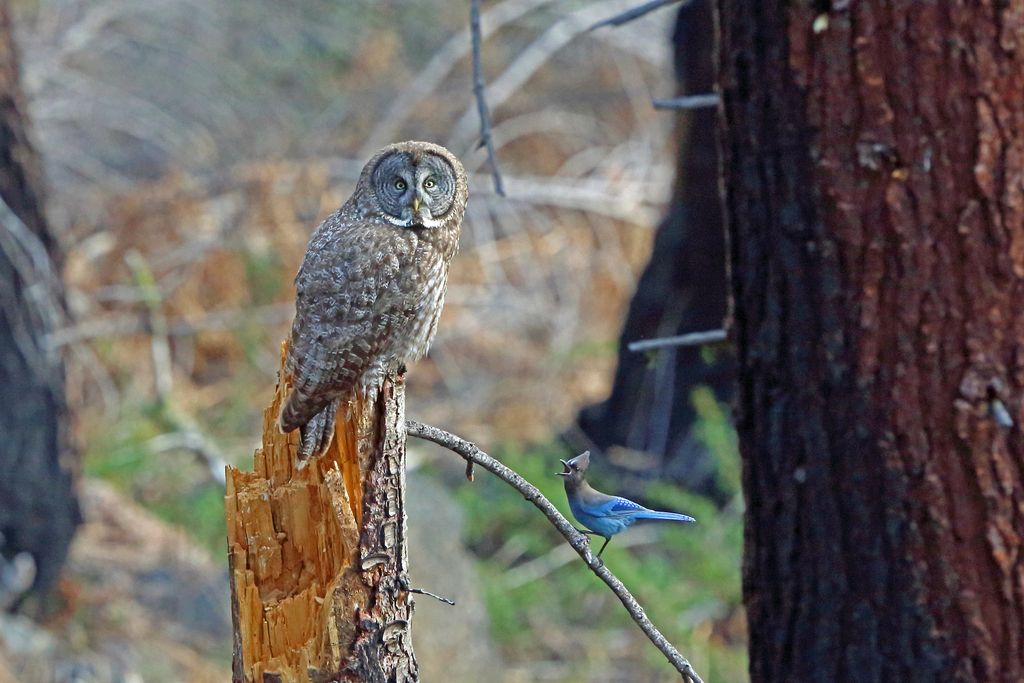
Photo: (c) Nigel Voaden, some rights reserved (CC BY) · CC BY 4.0 (May be cropped or resized)
Strix nebulosa
Basic stats
Diet
Mainly small rodents
Habitat
Dense northern coniferous forest near meadows or bogs
Range
Northern Eurasia and North America
Clutch size
2–5 eggs
Incubation period
28–36 days
Size
61–84cm
Wingspan
Usually 140–142cm; can exceed 152cm
Weight
580–1,900g
The great grey owl is an exceptionally long owl whose apparent bulk comes largely from dense feathers, a large head and a very long tail. Adults are grey above with pale barring and lighter, dark-streaked underparts. The rounded head has yellow eyes surrounded by dark rings, a huge facial disc and no ear tufts; a white bow-tie marking sits beneath the bill. Length is sixty-one to eighty-four centimetres, but its 580–1,900-gram weight is lower than that of several other large owls. Females average larger than males. (Wikipedia, general species account)
Across the north, great grey owls use dense coniferous taiga beside open meadows or bogs. The Eurasian subspecies ranges from Fennoscandia through Siberia to Mongolia, Manchuria and northeastern China. From low perches, an owl listens and watches before swooping onto prey, relying chiefly on small rodents. Its facial disc and asymmetrical ears help locate animals, even beneath deep snow. The species uses old raptor nests, broken tree tops or large cavities rather than building a nest, laying two to five eggs that are incubated for twenty-eight to thirty-six days. (Wikipedia, general species account)
Quick answers
- What does the Great Grey Owl eat?
- Mainly small rodents
- What habitat does the Great Grey Owl live in?
- Dense northern coniferous forest near meadows or bogs
- Where is the Great Grey Owl found?
- Northern Eurasia and North America
- How many eggs does the Great Grey Owl lay?
- 2–5 eggs
- How long are the eggs of the Great Grey Owl incubated?
- 28–36 days
- How big is the Great Grey Owl?
- 61–84cm
- What is the wingspan of the Great Grey Owl?
- Usually 140–142cm; can exceed 152cm
- How much does the Great Grey Owl weigh?
- 580–1,900g