 Wildlife
of Mongolia
Eurasian Eagle-Owl
Strigidae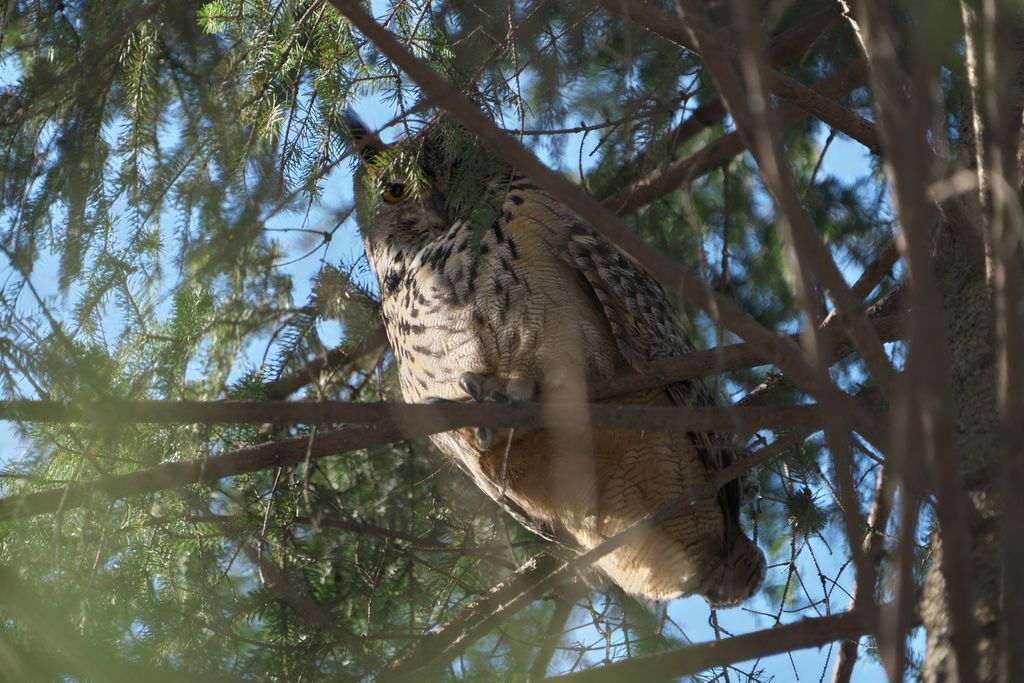
Photo: (c) Andrey Gulivanov, some rights reserved (CC BY) · CC BY 4.0 (May be cropped or resized)
Bubo bubo
Basic stats
Diet
Mainly rodents, rabbits and birds; also other vertebrates and large invertebrates
Habitat
Rocky and mountainous country, woodland edges, shrub openings, wetlands, forests and steppe
Range
Widely distributed across Europe and Asia
Clutch size
Usually 2–4 eggs
Size
Females up to 75cm
Wingspan
Females up to 188cm
The Eurasian eagle-owl is one of the largest owls. Females can reach 75 centimetres in length and span 188 centimetres, while males are somewhat smaller. Prominent ear tufts and vivid orange eyes are its most immediate field marks. The upperparts mix tawny with dark blackish mottling, the wings and tail are barred, and the buff underparts carry darker streaks. Its facial disc is comparatively weakly defined. More than a dozen geographic subspecies have been described across its immense Eurasian distribution. (Wikipedia, general species account)
Mostly nocturnal, this owl hunts chiefly small mammals such as rodents and rabbits, together with birds and occasionally larger mammalian prey. Reptiles, amphibians, fish, large insects and other invertebrates supplement the diet. It occupies rocky mountains, woodland edges, scrub openings, wetlands, conifer forest and steppe. Breeding sites are concealed on cliff ledges, in gullies or among rocks. The usual clutch contains two to four eggs; the female incubates and broods while the male supplies food, and both parents continue caring for young for months. (Wikipedia, general species account)
Quick answers
- What does the Eurasian Eagle-Owl eat?
- Mainly rodents, rabbits and birds; also other vertebrates and large invertebrates
- What habitat does the Eurasian Eagle-Owl live in?
- Rocky and mountainous country, woodland edges, shrub openings, wetlands, forests and steppe
- Where is the Eurasian Eagle-Owl found?
- Widely distributed across Europe and Asia
- How many eggs does the Eurasian Eagle-Owl lay?
- Usually 2–4 eggs
- How big is the Eurasian Eagle-Owl?
- Females up to 75cm
- What is the wingspan of the Eurasian Eagle-Owl?
- Females up to 188cm