
 Wildlife
of Mongolia
Two-barred Crossbill
Fringillidae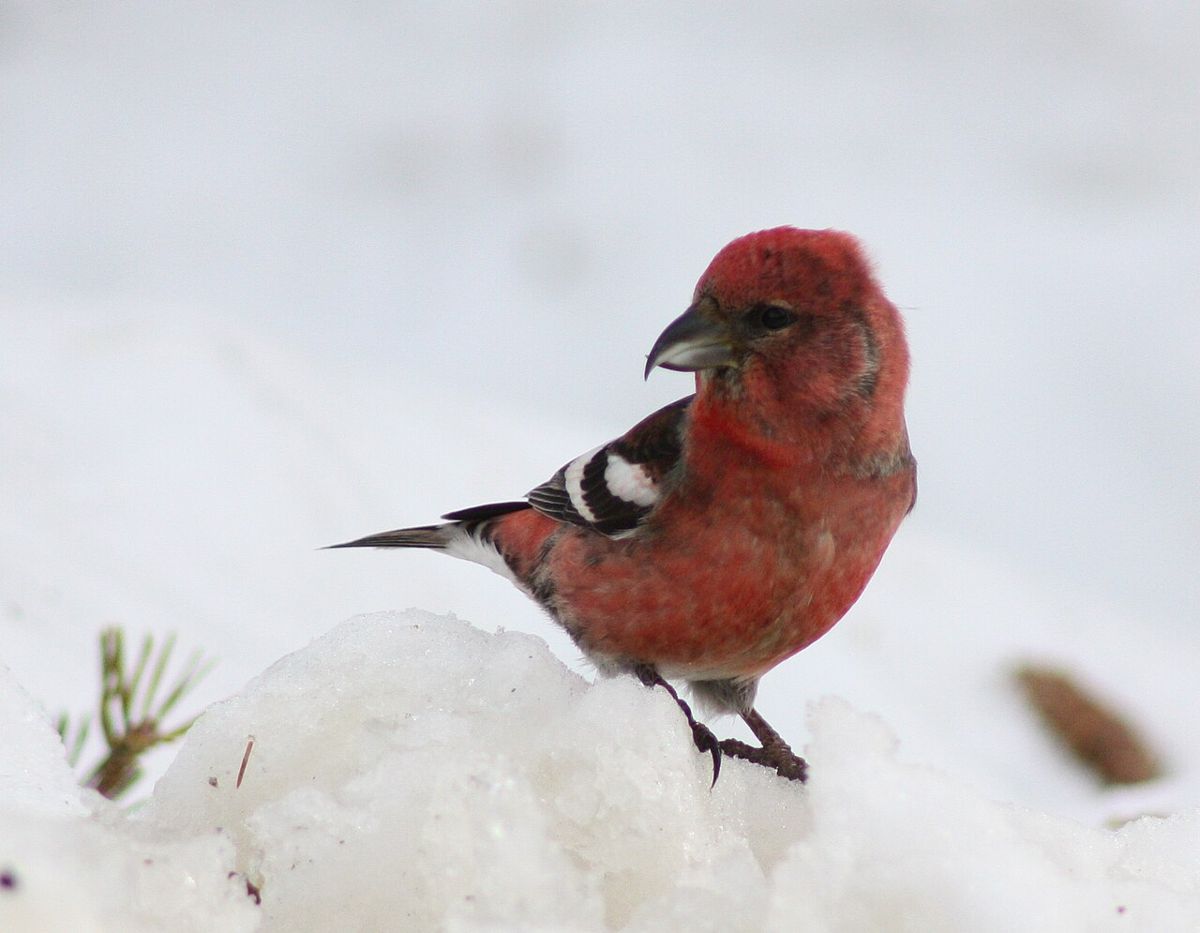
Photo: Estormiz · Public domain
Loxia leucoptera
Basic stats
Habitat
Coniferous forest
Range
Northern North America and the Palearctic
Size
14.5–17cm
Weight
25–40g
The two-barred crossbill, also called the white-winged crossbill, is a compact finch measuring 14.5–17 centimetres and weighing twenty-five to forty grams. It has short legs, a forked tail and the crossed bill characteristic of its genus. Two bold white wing-bars are its clearest field mark. Males are largely raspberry-red above with darker scapulars, whereas females replace the red with greenish-yellow tones. Compared with several other Palearctic crossbills, it has a smaller head and bill. (Wikipedia, general species account)
The species breeds in coniferous forests across northern North America and the Palearctic. Two subspecies are recognised: the Eurasian Loxia leucoptera bifasciata extends from northern Europe through eastern Siberia to northeastern China, while the nominate form occurs in Alaska, Canada and the northern United States. Johann Friedrich Gmelin formally described the species in 1789 from material associated with Hudson Bay and New York. The scientific epithet leucoptera derives from Greek words meaning white-winged, matching the bird's conspicuous paired wing-bars. (Wikipedia, general species account)
Quick answers
- What habitat does the Two-barred Crossbill live in?
- Coniferous forest
- Where is the Two-barred Crossbill found?
- Northern North America and the Palearctic
- How big is the Two-barred Crossbill?
- 14.5–17cm
- How much does the Two-barred Crossbill weigh?
- 25–40g