
 Wildlife
of Mongolia
Common Redshank
Scolopacidae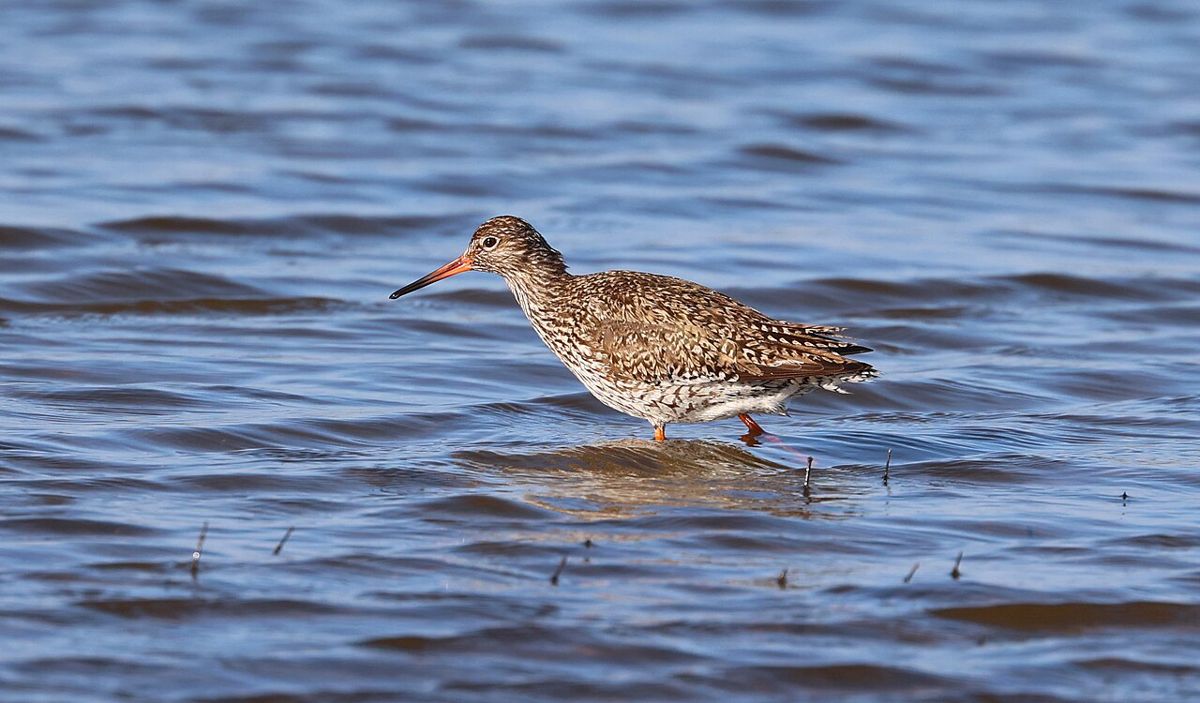
Photo: Clément Bardot · CC BY-SA 4.0 (May be cropped or resized)
Tringa totanus
Basic stats
Habitat
Wetlands from damp meadows to saltmarsh
Range
Temperate Eurasia; winters on Mediterranean and Atlantic coasts of Europe and in South Asia
Clutch size
3–5 eggs
In breeding plumage the common redshank is a marbled brown, slightly lighter below. In winter it becomes lighter-toned and less patterned, plain greyish-brown above and whitish below. It has red legs and a black-tipped red bill, and shows white up the back and on the wings in flight. The spotted redshank, an Arctic breeder, has a longer bill and legs, is almost entirely black in breeding plumage and very pale in winter, and is not a particularly close relative. (Wikipedia, general species account)
A widespread breeding wader across temperate Eurasia, the redshank is migratory, wintering on coasts around the Mediterranean, on the Atlantic coast of Europe from Ireland and Great Britain southwards, and in South Asia. It is wary and loud, drawing attention with a piping call. It nests in wetlands from damp meadows to saltmarsh, often at high density, laying three to five eggs, and like most waders feeds on small invertebrates. Birds are rare vagrants well outside this range. (Wikipedia, general species account)
Quick answers
- What habitat does the Common Redshank live in?
- Wetlands from damp meadows to saltmarsh
- Where is the Common Redshank found?
- Temperate Eurasia; winters on Mediterranean and Atlantic coasts of Europe and in South Asia
- How many eggs does the Common Redshank lay?
- 3–5 eggs