
 Wildlife
of Mongolia
Saiga
Bovidae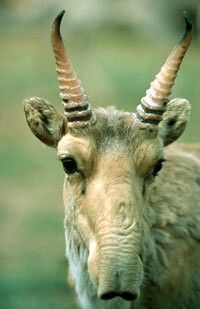
Photo: Unknown · Public domain
Saiga tatarica
Basic stats
Diet
Herbaceous steppe and semidesert plants
Habitat
Semidesert, steppe, and grassland
Range
Mongolian subspecies confined to western Mongolia
The saiga is unmistakable for its enlarged, flexible nose, with closely set nostrils directed downward. Its summer coat is yellowish to reddish and becomes pale grey-brown in winter; the Mongolian form may look sandy. Underparts are white. Only males carry the wax-coloured, slightly translucent horns, marked by pronounced rings. Winter hair lengthens around the neck into a mane, and the species moults in spring and autumn. The Mongolian population represents the distinct subspecies Saiga tatarica mongolica. (Wikipedia, general species account)
The Mongolian subspecies is confined to western Mongolia, where the account specifically places it around the Sharga and Mankhan nature reserves and within the Great Lakes Basin desert-steppe. Saigas graze a range of plants in semidesert, steppe, and grassland and form large herds capable of long movements and river crossings, while generally avoiding steep terrain. Breeding begins in November; successful males gather groups of females, and females assemble to give birth in spring. (Wikipedia, general species account; Wikipedia, Mongolian saiga account)
Quick answers
- What does the Saiga eat?
- Herbaceous steppe and semidesert plants
- What habitat does the Saiga live in?
- Semidesert, steppe, and grassland
- Where is the Saiga found?
- Mongolian subspecies confined to western Mongolia