
 Wildlife
of Mongolia
Moose
Cervidae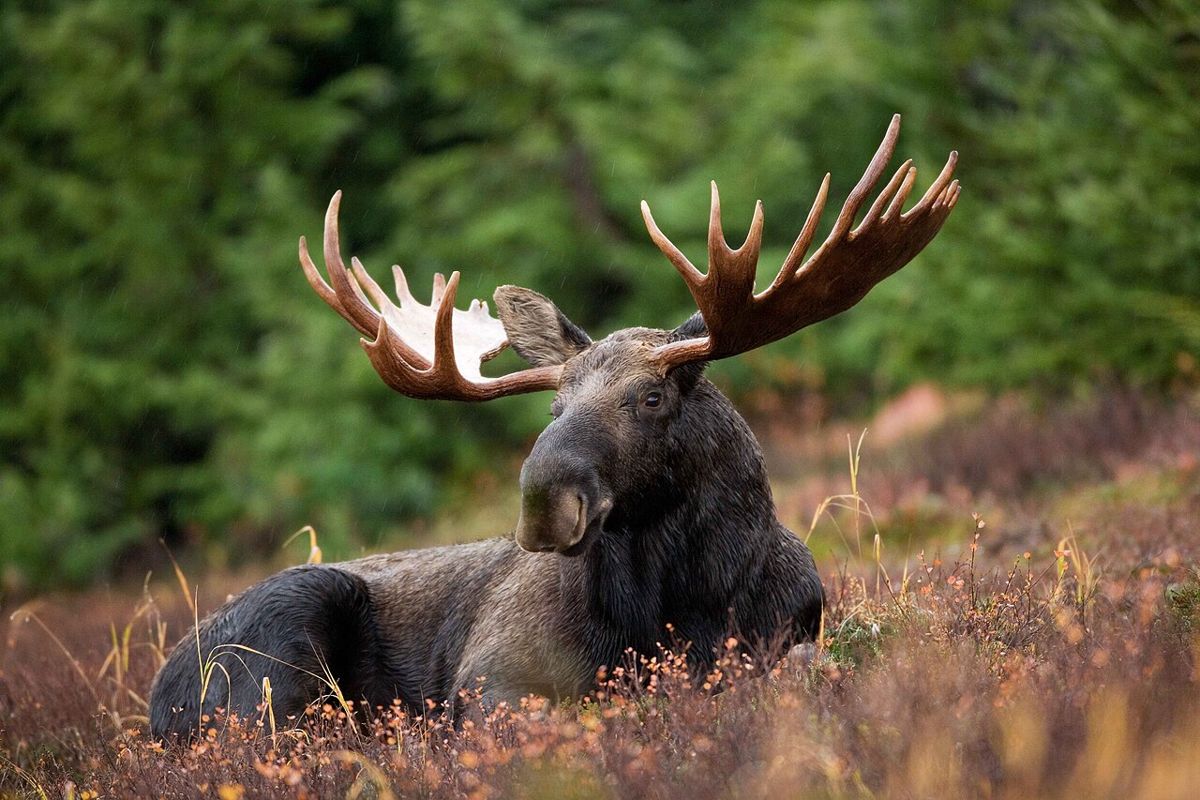
Photo: Ryan Hagerty · Public domain
Alces alces
Basic stats
Diet
Leaves, shoots, twigs, bark, and aquatic plants
Habitat
Boreal, mixed forest, wetlands, and young woodland
Range
Northern Eurasia and North America, including northern Mongolia
The moose is the largest living deer and the only living member of Alces. It has very long legs, a heavy body, an elongated muzzle, and a short neck. Adult males usually develop broad, palm-shaped antlers rather than the branching, pointed antlers typical of wapiti and many other deer. These proportions give the animal a high-shouldered outline suited to moving through deep snow and wet ground. The species is distributed through cool forests across the Northern Hemisphere, including Mongolia. (Wikipedia, general species account)
Moose browse rather than graze, eating leaves, shoots, twigs, bark, and aquatic plants according to season. They favour mosaics of young forest for feeding, mature woodland for shelter, and marshes, lakes, or river margins for aquatic forage and summer cooling. Adults are usually solitary except for cows accompanied by calves. In Mongolia, national reporting recognises Ussurian and East Siberian forms, while distribution research reports animals from the Nomrog River basin, the Khentii, and the Khangai ranges. (Wikipedia, general species account; Mongolian Red List of Mammals 2006; Jensen et al. 2020)
Quick answers
- What does the Moose eat?
- Leaves, shoots, twigs, bark, and aquatic plants
- What habitat does the Moose live in?
- Boreal, mixed forest, wetlands, and young woodland
- Where is the Moose found?
- Northern Eurasia and North America, including northern Mongolia