 Wildlife
of Mongolia
Great Reed Warbler
Acrocephalidae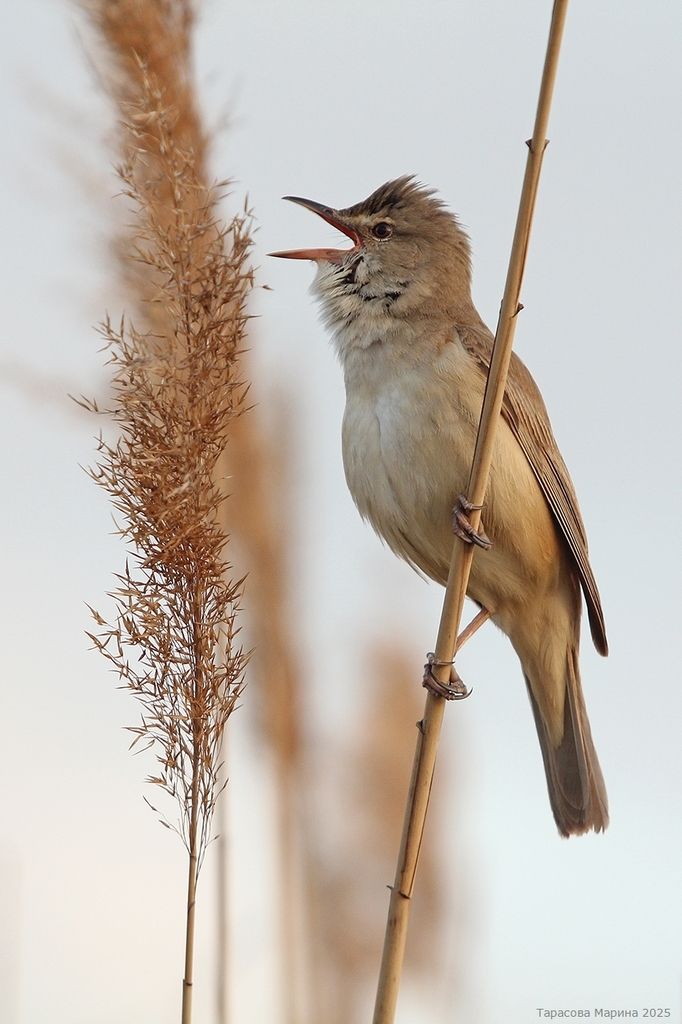
Photo: (c) Марина Тарасова, some rights reserved (CC BY) · CC BY 4.0 (May be cropped or resized)
Acrocephalus arundinaceus
Basic stats
Diet
Insects
Habitat
Reed beds when breeding; reed beds, bush thickets, rice fields and forest clearings in winter
Range
Breeds throughout mainland Europe and the western Palearctic; winters in sub-Saharan Africa
Size
16–21cm
Wingspan
25–30cm
Weight
22–38g
The great reed warbler is a thrush-sized warbler and the largest of its family, 16–21 centimetres long with a wingspan of 25–30 centimetres, weighing 22–38 grams. The adult has unstreaked brown upperparts and dull buffish-white chin and underparts, a flattened forehead and a strong, pointed bill. It looks very much like a giant common reed warbler but with a stronger supercilium. The sexes are identical, as in most Old World warblers, though young birds are richer buff below. (Wikipedia, general species account)
An insect-eating warbler, it breeds throughout mainland Europe and the western Palearctic and migrates to sub-Saharan Africa in winter. It favours reed beds in the breeding season, and lives in reed beds, bush thickets, rice fields and forest clearings in winter. Sexual dimorphism is relatively low, and the species mates both polygynously and monogamously. (Wikipedia, general species account)
Quick answers
- What does the Great Reed Warbler eat?
- Insects
- What habitat does the Great Reed Warbler live in?
- Reed beds when breeding; reed beds, bush thickets, rice fields and forest clearings in winter
- Where is the Great Reed Warbler found?
- Breeds throughout mainland Europe and the western Palearctic; winters in sub-Saharan Africa
- How big is the Great Reed Warbler?
- 16–21cm
- What is the wingspan of the Great Reed Warbler?
- 25–30cm
- How much does the Great Reed Warbler weigh?
- 22–38g