
 Wildlife
of Mongolia
Five-toed Pygmy Jerboa
Dipodidae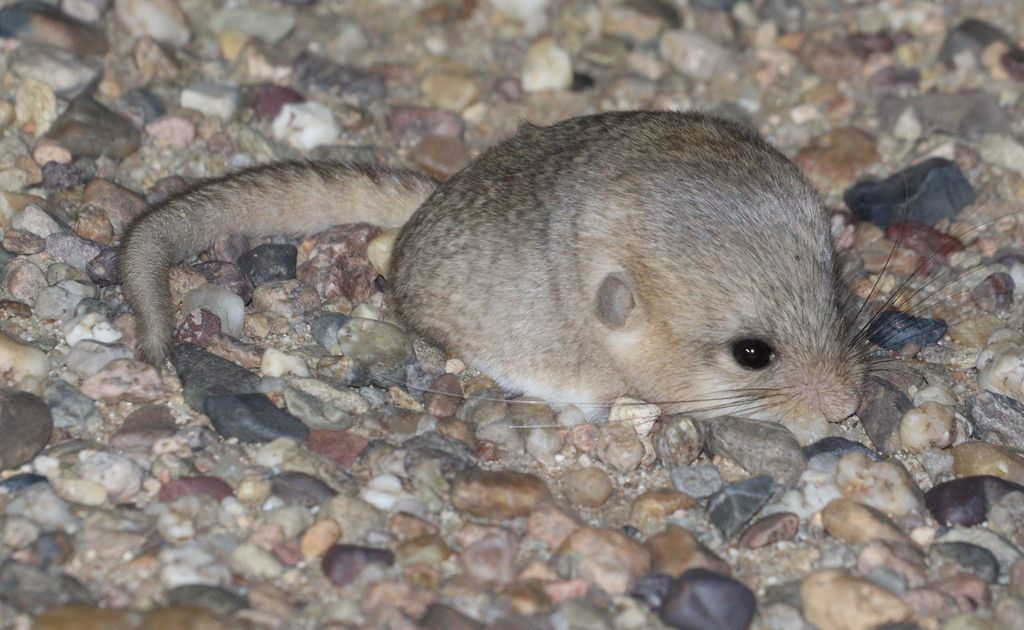
Photo: (c) Jan Ebr & Ivana Ebrová, some rights reserved (CC BY) · CC BY 4.0 (May be cropped or resized)
Cardiocranius paradoxus
Basic stats
Diet
Seeds and grain; stores fat in the tail in summer
Habitat
Rocky deserts, arid steppes and sandy deserts with grasses, Stipa, Artemisia arenaria and Cleistogenes songorica
Range
Deserts and semi-deserts of southwestern Mongolia, Tuva, Xinjiang, Gansu, Ningxia, Inner Mongolia and eastern Kazakhstan
Size
Head and body 4.5–6.0cm; tail 5.9–7.8cm
Weight
Up to 12g
The five-toed pygmy jerboa is a small rodent with a head-and-body length of 45–60 millimetres, a tail of 59–78 millimetres, hind feet of 22–27 millimetres, ears of 5–6 millimetres, and a weight up to 12 grams. The head is enormous, about 40 percent of the body length, with small eyes and short tubular ears. The fur is long, dense and soft, grey-yellow to ochre above and white below, with a thin yellow-red stripe along the flanks, and the whiskers are very long. The long, narrow feet have five toes, the first non-functional and the fifth short and set back, with a tuft of bristles on the soles. The tail is longer than the head and body. (Italian Wikipedia, general species account)
It is ground-living, solitary and nocturnal, sheltering in burrows in sandy hills or among rocks, preferably dug by other animals, and it hibernates for about seven months a year. It eats seeds and grain and stores fat in the tail in summer. It breeds once a year. It lives in the deserts and semi-deserts of southwestern Mongolia, the Siberian region of Tuva, the Chinese provinces of Xinjiang, Gansu, Ningxia and Inner Mongolia, and eastern Kazakhstan, in rocky deserts, arid steppes and sandy deserts with grasses. (Italian Wikipedia, general species account)
Quick answers
- What does the Five-toed Pygmy Jerboa eat?
- Seeds and grain; stores fat in the tail in summer
- What habitat does the Five-toed Pygmy Jerboa live in?
- Rocky deserts, arid steppes and sandy deserts with grasses, Stipa, Artemisia arenaria and Cleistogenes songorica
- Where is the Five-toed Pygmy Jerboa found?
- Deserts and semi-deserts of southwestern Mongolia, Tuva, Xinjiang, Gansu, Ningxia, Inner Mongolia and eastern Kazakhstan
- How big is the Five-toed Pygmy Jerboa?
- Head and body 4.5–6.0cm; tail 5.9–7.8cm
- How much does the Five-toed Pygmy Jerboa weigh?
- Up to 12g