
 Wildlife
of Mongolia
Swan Goose
Other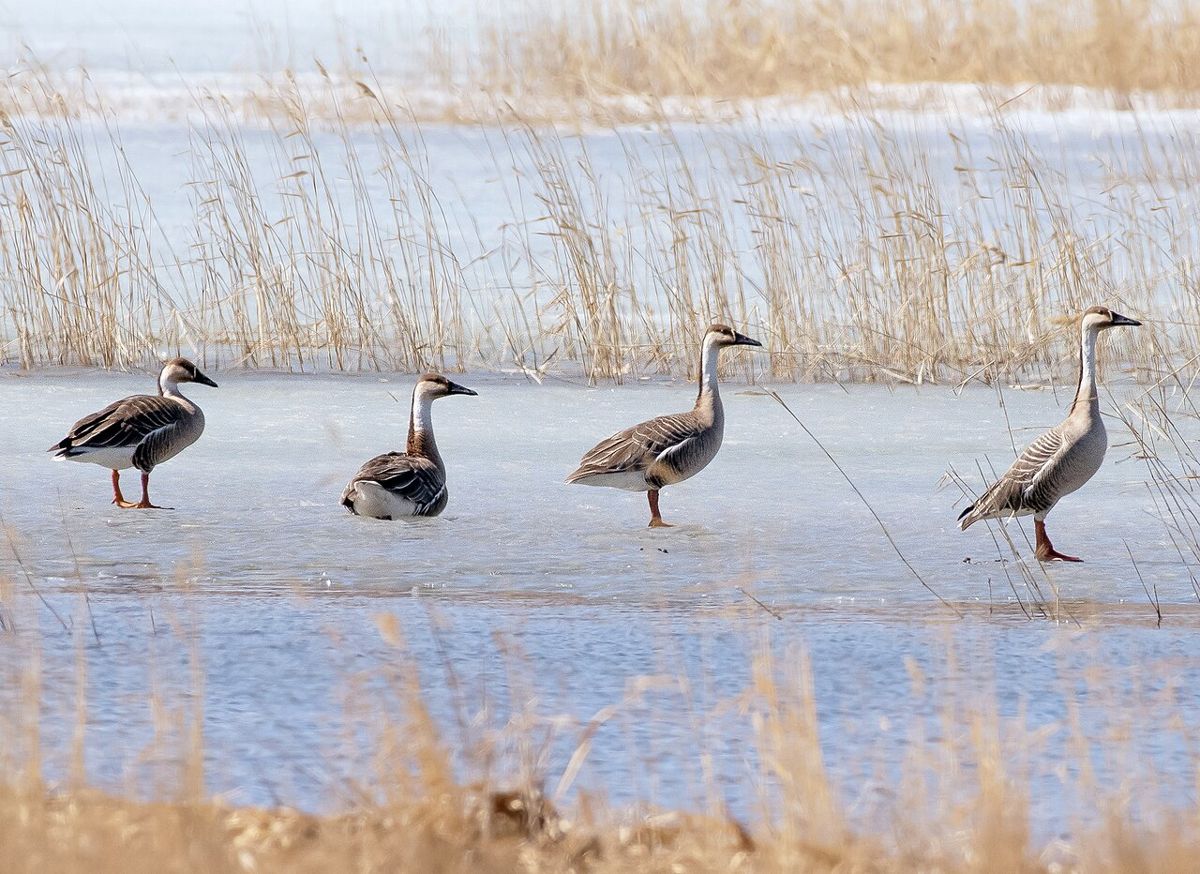
Photo: grihahasanov · CC BY 4.0 (May be cropped or resized)
Anser cygnoid
Basic stats
Diet
Grasses, roots, seeds, and aquatic plants
Habitat
Wetlands beside grassland, including lakes, rivers, ponds, and coasts
Range
Eastern Asia; breeds around Mongolia and migrates to the Yangtze basin
Clutch size
Usually 5–6 eggs
Incubation period
28–34 days
Size
81–94cm
Wingspan
160–185cm
Weight
About 3.15kg
The Swan Goose is a large East Asian goose measuring 81–94 centimetres, with a 160–185-centimetre wingspan and an average weight near 3.15 kilograms. Its head and neck are strongly two-toned, the bill is stocky and black, and the feet are orange. Adults show dark-brown wings and back, with the breast becoming darker toward the belly, while the rear underparts are white and the tail dark. Males and females look much alike, although males average slightly larger. (Animal Diversity Web account)
Wild Swan Geese spend summer around the Mongol Daguur steppe and migrate south toward the Yangtze River basin, using lakes, rivers, ponds, wetlands, estuaries, and adjacent grasslands. They graze on grasses and also take roots, seeds, and aquatic plants. Courtship includes shaking, preening, and head-bobbing, and pairs are generally monogamous through the breeding season. Egg laying begins in late April or early May. A female averages five to six eggs, incubation lasts 28–34 days, and young usually fledge at about eight weeks. (Animal Diversity Web account)
Quick answers
- What does the Swan Goose eat?
- Grasses, roots, seeds, and aquatic plants
- What habitat does the Swan Goose live in?
- Wetlands beside grassland, including lakes, rivers, ponds, and coasts
- Where is the Swan Goose found?
- Eastern Asia; breeds around Mongolia and migrates to the Yangtze basin
- How many eggs does the Swan Goose lay?
- Usually 5–6 eggs
- How long are the eggs of the Swan Goose incubated?
- 28–34 days
- How big is the Swan Goose?
- 81–94cm
- What is the wingspan of the Swan Goose?
- 160–185cm
- How much does the Swan Goose weigh?
- About 3.15kg